
Ethan Kross, Best-Selling Author and Professor

Today, my guest is Ethan Kross, one of the world’s leading experts on controlling the conscious mind. An award-winning professor and bestselling author in the University of Michigan’s top ranked Psychology Department and its Ross School of Business, he studies how the conversations people have with themselves impact their health, performance, decisions and relationships.
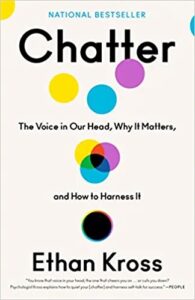
Ethan is the author the National Bestseller Chatter: The Voice in Our Head, Why it Matters and How to Harness It, which was chosen as one of the best new books of the year by the Washington Post, CNN and USA Today and the Winning Winter 2021 selection for Malcolm Gladwell, Adam Grant, Susan Cain and Dan Pink’s Next Big Idea Book Club. Ethan attended the University of Pennsylvania and earned his PhD in Psychology from Columbia University. Ethan moved to the University of Michigan in 2008, where he founded the Emotion & Self Control Laboratory.
In this candid conversation, Ethan shared the real stories behind his early introduction to introspection, the dual nature of our inner voice, and the practical scientific tools we can use to manage our mental chatter.
1. An Unconventional Upbringing. Ethan revealed that his lifelong fascination with the human mind started around age three with his unconventional father in Brooklyn. Instead of giving him a “time out” when he faced a difficulty, his dad actively taught him to “go inside” and find a solution through introspection. This unique focus on the mind continued throughout his childhood; in fact, when Ethan turned five and eagerly asked for a bicycle for his birthday, his father gave him a meditation mantra instead.
2. The Puzzle of Chatter. While taking his first psychology class in college, Ethan realized that the exact same introspective tool that drives brilliant human innovation—allowing us to build spaceships and discover vaccines—can also be an enormous source of personal suffering. He became determined to solve the puzzle of why our powerful minds can so easily jam up and trap us in endless negative loops of rumination, worry, and catastrophizing, a universal human phenomenon he aptly termed “chatter”.
3. Solomon’s Paradox and Time Travel. To combat this negative looping, Ethan relies on a tool called “distanced self-talk,” which counteracts “Solomon’s Paradox”—our innate tendency to give great advice to others while making terrible decisions for ourselves. By silently coaching himself using his own name, he essentially turns on his brain’s machinery for thinking about other people, instantly granting himself the psychological distance needed to reason wisely. Additionally, when hit with intense 2 A.M. anxiety, he uses “mental time travel” to actively imagine how he will feel about the problem the next morning or ten years down the line, deliberately broadening his perspective to provide immediate emotional relief.
4. The Danger of Venting. Ethan explained that simply venting our emotions to a supportive friend actually doesn’t help us work through chatter; while it feels good and strengthens the relationship, it simply rehashes the negativity without solving the underlying issue. A truly effective “chatter advisor” will first listen with compassion, but then actively shift the conversation toward cognitive problem-solving. Furthermore, for colleagues or loved ones who haven’t explicitly asked for help, he strongly recommends providing “invisible support”—such as quietly taking over their household chores without ever asking for credit—to ease their burden without threatening their sense of autonomy.
