Chip Heath, NY Times Best Selling Author

Today, my guest is Chip Heath, a Professor at the Stanford Graduate School of Business who teaches courses on business strategy and organizational behavior. He is the co-author (along with his brother, Dan Heath) of four books.

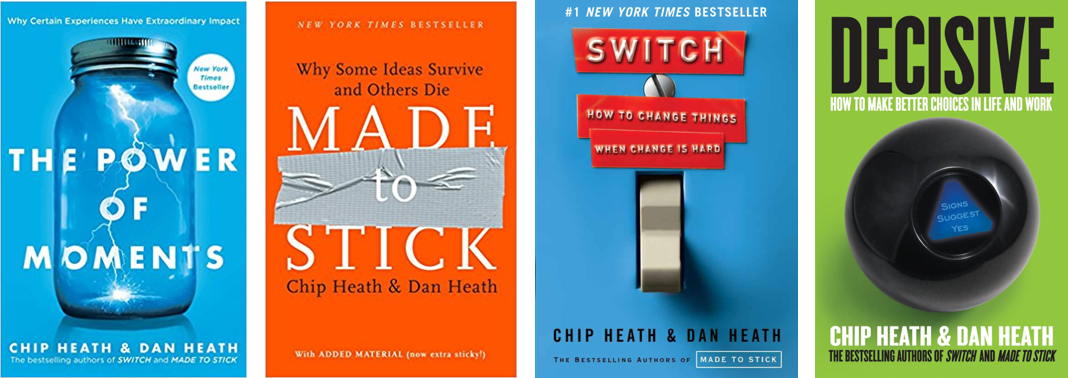
Their latest book (an instant New York Times and Wall Street Journal bestseller) The Power of Moments: Why Certain Experiences Have Extraordinary Impact was published in the Fall of 2017. Decisive: How to Make Better Decisions in Life and Work was published in spring of 2013 and debuted at #1 on the Wall Street Journal bestseller list and #2 on the New York Times.
Their 2010 book, Switch: How to Change Things When Change is Hard, hit #1 on both bestseller lists. Their first book, Made to Stick: Why Some Ideas Survive and Others Die, spent two years on the Business Week bestseller list and was an Amazon Top 10 Business Book for both editors and readers. Chip holds a PhD in Psychology from Stanford University and a BS in Industrial Engineering from Texas A&M.
In this candid conversation, Chip shared the real stories behind his transition from engineering to psychology, his fascination with how ideas spread, and the profound impact of crafting memorable moments.
1. An Engineered Approach to Psychology. Chip revealed that he originally started his academic career studying engineering at Texas A&M because he believed it was the proper path for someone good at math and science. However, after reading an autobiography of a cognitive scientist during his junior year, he felt like he was "coming home" and pivoted to his true sweet spot of social science. Despite the shift, he still fundamentally thinks like an engineer, actively using analytical concepts like free-body diagrams to isolate elements and forces when teaching his students about organizational behavior.
2. The Survival of Bogus Ideas. Chip explained that the concept for his first book originated from the quirky observation that completely bogus ideas—such as the myth that humans only use 10% of their brains—can easily survive in the "marketplace of ideas" for over a century. Fascinated by how easily false concepts outcompete true ones, he began researching how to apply those exact same principles to make truthful, important ideas more likely to "stick". To write the book, he teamed up with his brother Dan, whom Chip openly credits as a "world-class writing talent" and the true star of their collaboration.
3. Tripping Over the Truth. Discussing his book The Power of Moments, Chip highlighted the power of creating sudden moments of insight, where people viscerally "trip over the truth". He shared a provocative story about sanitation workers trying to stop open defecation in rural villages. Instead of lecturing, the workers simply walked around asking the villagers questions about the local flies and dogs, systematically leading the crowd to the sudden, horrifying realization that they were effectively eating each other's waste. By forcing this intense, emotional crisis, the workers were able to instantly change practices that had been deeply ingrained for decades.
4. Testing Ideas Like an Entrepreneur. When deciding which topics are actually worth dedicating years of his life to, Chip relies on a highly empirical approach. Just like a startup founder testing a new app, he pitches his book outlines to actual organizations; if an idea doesn't resonate—like a recent concept he had about organizational "silos"—he simply drops it and moves on. While he loves the initial academic process of starting new projects and asking questions, he actually finds some of his greatest professional pleasure today in consulting one-on-one with early-stage entrepreneurs to help them rapidly clarify their ideas and strategies.
