
Adam Grant, Organizational Psychologist and TED Speaker
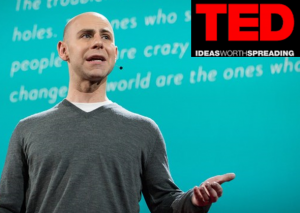
Today, my guest is Adam Grant, one of Wharton’s top-rated professors, 2 time TED Speaker and best selling New York Times author on work and psychology.

He has been recognized as one of the world's 25 most influential management thinkers, the 100 most creative people in business, the 40 best business professors under 40, and one of Malcolm Gladwell’s favorite thinkers.
Adam is the author of two New York Times bestselling books: Originals which explores how individuals champion new ideas and leaders fight groupthink; and Give and Take which examines why helping others drives our success. Adam earned his Ph.D. in organizational psychology from the University of Michigan, and his B.A. from Harvard University, magna cum laude with highest honors and Phi Beta Kappa honors.
In this candid conversation, Adam shared the real stories behind his early career failures, his groundbreaking research on givers and takers, and his philosophy on data, experience, and productivity.
1. The Advertising Anomaly. Adam revealed that his interest in generosity at work actually began with a massive personal failure. During his first real job selling advertising for travel books, he wanted to help his small business clients succeed so badly that he gave them massive discounts and refunds. He ultimately became the only person in company history to actually lose money that was already on the books, which sparked his lifelong curiosity about how to successfully combine benevolence with professional success.
2. The Myth of the Matcher. Expanding on the core concepts of Give and Take, Adam explained that most professionals try to play it safe by being "matchers"—people who keep score and only help others if they receive an equal favor in return. However, his research surprisingly revealed that the most effective and successful people (as well as the absolute worst performers) are actually the "givers". He learned that ultimate success isn't necessarily about having the most raw talent, but rather about having a smart strategy for how, when, and whom you choose to help.
3. Why Experience is Overrated. As a remarkably young professor, Adam frequently faced skepticism, particularly when teaching leadership to veteran US Air Force colonels and generals who bluntly dismissed him in their evaluations for his lack of real-world experience. He countered this criticism by realizing that personal experience is vastly overrated as a base of knowledge; just as driving a car doesn't make someone a mechanic, having a few idiosyncratic personal experiences doesn't equate to genuine expertise. He argues that gathering data is far superior because it allows you to learn from 10,000 aggregated experiences rather than relying on just your own.
4. The Secret of Serial Processing. Managing a demanding career as a researcher, author, speaker, and professor, Adam strictly rejects multitasking, noting that human beings are terrible at "parallel processing". Instead, he completely compartmentalizes his year through "serial processing". He dedicates August through December almost exclusively to his profound love of teaching, and reserves January through July entirely for writing, consulting, and launching new research projects.
