
Ayelet Fishbach, Author of “Get it Done”

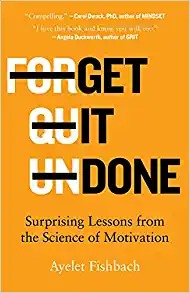
Today, my guest is Ayelet Fishbach, Ph.D., the Jeffrey Breakenridge Keller Professor of Behavioral Science and Marketing at the University of Chicago, Booth School of Business, and the author of GET IT DONE: Surprising Lessons from the Science of Motivation. She is the past president of the Society for the Science of Motivation and the International Social Cognition Network.
Ayelet is an expert on motivation and decision making. Ayelet’s groundbreaking research on human motivation has won the Society of Experimental Social Psychology’s Best Dissertation Award and Career Trajectory Award, the Society of Consumer Psychology’s Distinguished Scientific Contribution award, and the Fulbright Educational Foundation Award. Ayelet earned a bachelor’s degree with distinction in psychology in 1992, a master’s degree summa cum laude in psychology in 1995, and a PhD magna cum laude in psychology in 1999, all from Tel Aviv University. She joined the Chicago Booth faculty in 2002.
In this candid conversation, Ayelet shared the real science behind motivation, the hidden traps of goal-setting, and why true progress often requires embracing deep discomfort.
1. The Knowledge of Motivation. Ayelet debunked the common misconception that motivation is simply an emotional feeling or a “muscle” that can be lost. Instead, she explained that motivation is actually a rational form of knowledge; it is the strategic ability to design your environment to make achieving your goals more likely. She broke this down into four critical categories: setting the right goal, actively monitoring progress (especially during the inevitable slump of the “middle problem”), fitting the goal among other life priorities, and securing the right social support.
2. The Tote Bag Paradox. When analyzing why people fail to get things done, Ayelet noted that people frequently set the wrong types of goals by focusing on chores or “means” rather than intrinsically motivating outcomes. She illustrated this with a fascinating study where students were willing to bid $20 for a specific book, but only $12 for a tote bag that contained that exact same book. Because people inherently hate paying for prerequisites—like shipping, parking, or difficult pre-med classes—she stressed that we must conceptually “fuse” these stepping stones with the ultimate goal, training ourselves to see a boring chemistry class as the direct act of becoming a doctor.
3. Learning by Elimination. Although failure is an inevitable part of success, Ayelet warned that humans are exceptionally bad at learning from setbacks. Not only do failures sting emotionally, but they also only teach us “by elimination”—showing us what not to do rather than what we should do. To overcome this difficult cognitive barrier, she highly recommends that anyone experiencing a severe setback should actively try giving advice to another person struggling with the exact same issue, as forcing yourself to give advice simultaneously forces you to learn from your own mistakes and gets you back on your feet.
4. Embracing Discomfort. When studying how to get people to initiate difficult new activities, Ayelet discovered profound results by explicitly instructing people to seek out awkwardness. For example, when working with the famous Second City improvisation club, she found that students who were actively told to have the goal of feeling uncomfortable and deliberately making mistakes were far more engaged and willing to initiate tough activities. Furthermore, she often helps her own students realize that seemingly conflicting goals—like getting enough sleep versus finishing a late-night assignment—are actually completely symbiotic when properly reframed as necessary, supporting pillars of both mental health and academic success.
