
Annie Duke, Decision Strategist / Prof. Poker Player

Today, my guest is Annie Duke, an author, former professional poker player, corporate speaker, and consultant in the decision-making space, as well as Special Partner focused on Decision Science at First Round Capital Partners, a seed stage venture fund. Annie’s latest book is Quit: The Power of Knowing When to Walk Away from Portfolio, a Penguin Random House imprint.
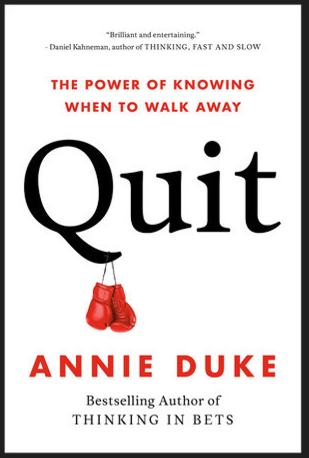
Her previous book, Thinking in Bets, is a national bestseller. As a former professional poker player, she has won more than $4 million in tournament poker. During her career, Annie won a World Series of Poker bracelet and is the only woman to have won the World Series of Poker Tournament of Champions and the NBC National Poker Heads-Up Championship. She retired from the game in 2012.

Prior to becoming a professional poker player, Annie was awarded a National Science Foundation Fellowship to study Cognitive Psychology at the University of Pennsylvania. Annie is the co-founder of The Alliance for Decision Education, a non-profit whose mission is to improve lives by empowering students through decision skills education. She is also a member of the National Board of After-School All-Stars and the Board of Directors of the Franklin Institute. Annie holds degrees in Cognitive Psychology from University of Pennsylvania and Columbia University.
In this candid conversation, Annie shared the real stories behind her accidental entry into professional poker, her psychological edge at the table, and her eventual transition into a decision strategist.
1. A Forced Quitting Event. Annie revealed that her 18-year professional poker career actually began due to an unexpected “forced quitting” event. While finishing graduate school and preparing for her job talks to become a professor, she became incredibly sick and was hospitalized for a couple of weeks. Needing a way to make ends meet while recuperating on a tight budget, her brother—a professional player himself—suggested she try playing poker, a game she quickly started making money at and fell in love with.
2. Compressing the Emotional Range. Unlike some highly talented players who had a brilliant “A game” but would completely fall apart or go on “tilt” when facing a bad mathematical beat, Annie’s greatest advantage was her remarkably compressed emotional range. She attributed this deep emotional resilience to growing up with a severely alcoholic mother, which forced her as a child to develop the ability to quickly “flush” unpredictable, capricious situations just to survive. Because she consistently played in the B+ to A range, she could steadily beat more talented players whose emotions caused them to play incredibly poorly.
3. The Harsh Realities of the Poker Table. Despite her immense success and love for the game’s strategy, Annie deeply disliked the culture of the poker world, where only 3 to 5 percent of professional players were women. Operating without an HR department in a highly stressful environment, she constantly faced emotional aggression and inappropriate sexualization from angry male players. Looking back, she admits to mourning that younger version of herself, noting she wishes someone had steered her into a field like financial trading where she could have exercised the exact same mental skills but with better professional guardrails.
4. The Value of Keeping Options Open. Instead of an abrupt career switch, Annie slowly transitioned out of poker by running her interests in parallel, relying on the poker-player mentality that “option value” is highly important. Starting in 2002, she began giving talks to hedge funds about the intersection of cognitive science, poker, and risk. This eventually blossomed into a massive consulting business, leading her to write several books and work with venture capital firms like First Round Capital to completely overhaul their decision-making hygiene and partner voting processes.
