John Hennessy, Chairman of Alphabet (Google)

Today, my guest is Professor John Hennessy, Chairman of Alphabet (Google), Director of the Knight-Hennessy Scholars Program at Stanford, President Emeritus of Stanford University, Co-Founder of MIPS Computer Systems and Author of Leadership Matters.

A pioneer in computer architecture, John joined Stanford’s faculty in 1977 as an assistant professor of electrical engineering. He cofounded MIPS Computer Systems in 1984 and Atheros Communications in 1998 where he served as Chair of the Board until 2010.
John was the inaugural Willard R. and Inez Kerr Bell Professor of Electrical Engineering and Computer Science, and served as chair of Computer Science, Dean of the School of Engineering, and University Provost, before being inaugurated as Stanford’s 10th President.
His honors include the 2012 Medal of Honor of the Institute of Electrical and Electronics Engineers, its highest award; the 2017 ACM Turing Prize (with David Patterson); the 2000 John von Neumann Medal; the 2001 Seymor Cray Computer Engineering Award; a 2004 NEC C&C Prize for lifetime achievement in computer science and engineering.
He is an elected member or Fellow of the National Academy of Engineering, the Royal Academy of Engineering, The National Academy of Science, the American Academy of Arts and Sciences, and the American Philosophical Society. John earned his BS in Electrical Engineering from Villanova University and his MS and PhD in computer science from Stony Brook University, as well as ten honorary doctorates.
In this candid conversation, John shared the real stories behind his unexpected transition from an engineer to the president of Stanford University, his philosophy on servant leadership, and his mission to train the next generation of global leaders.
1. The Tinkering Academic. John revealed that he was always a "tinkerer" who naturally gravitated toward engineering and computer science, noting that computer science is essentially an engineering discipline focused on building things. Though he initially focused deeply on academic research—particularly developing risk computing technology in the 1980s—he discovered a profound dual love for solving cutting-edge problems and experiencing the thrill of seeing a student deeply master a difficult concept in his classroom.
2. The Boiling Frog of Leadership. Never intending to leave his regular academic roots for administration, John likened his gradual entry into university leadership to a "frog in the pot of water," where the temperature is slowly turned up until the frog is fully cooked. He originally planned to serve as Stanford's president for about ten years, but ultimately stayed for 16, using that time to proudly champion financial aid initiatives that made the institution accessible to students who previously would have experienced "sticker shock".
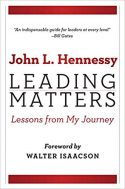
3. The Upside-Down Pyramid. When writing his book Leading Matters, John emphasized that true leadership is fundamentally about service rather than seeking a fancy title. He views his former presidential role as an "upside-down pyramid" where the leader sits at the very bottom to support everyone else's work. Furthermore, he stresses that the most vital leadership characteristic is humility—which gives a leader the confidence to ask for help and acknowledge that, especially in an academic setting, there are always students or colleagues who know more than they do.
4. Inspiring Through Storytelling. Recognizing a massive void in both corporate and government leadership today, John now dedicates his time to the Knight-Hennessy program, mentoring a highly capable, global cohort of students devoted to making a difference. Admitting he isn't a natural public speaker and prefers interactive Q&A sessions, he actively teaches these future leaders the critical art of storytelling, believing that weaving a memorable narrative is the ultimate way to inspire people and guide them toward a shared vision.
